
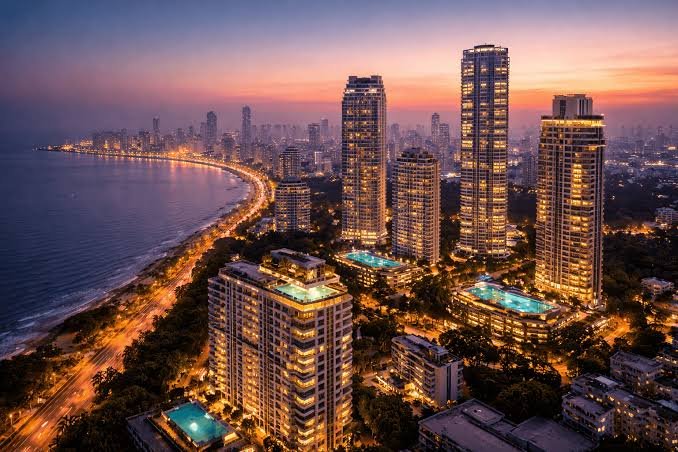
Luxury real estate in India is one of the most overused — and most misunderstood — phrases in the property market. Walk into any developer’s showroom in Gurugram or Mumbai and you’ll find the word plastered across every brochure, every hoarding, and every sales pitch, regardless of whether the product deserves it.
The result? Buyers — especially HNIs and NRIs investing serious capital — are left navigating a market where “luxury” has been applied to everything from ₹80 lakh apartments with granite countertops to ₹50 crore branded penthouses with round-the-clock concierge and private lift lobbies.
So what does luxury real estate in India actually mean in 2026? The answer requires moving beyond price per square foot and understanding five defining dimensions: price, location, specification, developer brand, and the buyer experience itself.
The Luxury Real Estate Market in India: Where It Stands in 2026
Before defining luxury, it helps to understand the scale of the market it occupies.
India’s luxury residential real estate market is valued at USD 64.21 billion in 2026, growing at a CAGR of 10.95% and projected to reach USD 107.99 billion by 2031. This is not a niche segment — it is a structural pillar of India’s residential property economy.
Homes priced above ₹1 crore now account for 71% of total residential sales nationally — up from 59% just a year earlier. The ₹15–30 million bracket alone grew 67% year-on-year. The centre of gravity of the Indian property market has shifted decisively upward.
Sales of homes priced ₹4 crore and above rose nearly 28% year-on-year across India’s top 7 cities in 2025, with Q1 2025 alone recording 1,930 luxury home units sold.
This is the market where Clearhead Estates operates — and understanding what genuinely qualifies as luxury within it is the foundation of every investment decision we guide our clients through.
[Internal link: See our guide to HNI vs NRI real estate investment in India →]
Dimension 1: The Price Floor — Necessary, But Not Sufficient
The most common question we hear: “At what price does a property become luxury real estate in India?”
In India’s major metros, true luxury begins at ₹5 crore — though this threshold varies materially by micro-market. A ₹5 crore apartment on Golf Course Road in Gurugram is a credible luxury asset. The same budget in Malabar Hills or Bandra West buys you something significantly more modest.
For NRI buyers investing from Dubai, Singapore, or London, a practical reference frame: Indian luxury real estate broadly spans USD 600,000 to USD 6 million, depending on city and address.
Ultra-luxury — the tier of branded residences, trophy penthouses, and curated bungalows on irreplaceable land — begins at ₹20 crore in Mumbai and Delhi NCR and extends well above ₹100 crore for the most exceptional assets.
But price is the entry ticket to the conversation, not the definition itself. A ₹10 crore apartment in a poorly located tower with generic specifications is not luxury real estate. A ₹6 crore property on a heritage-adjacent plot in South Delhi with impeccable construction quality may well be.
The price floor is where you start screening. The dimensions below are where you decide.
Dimension 2: Location — The Only Truly Non-Negotiable
Luxury real estate in India, by definition, occupies land that cannot be replicated.
In Mumbai, that means Altamount Road, Malabar Hills, Worli Sea Face, Bandra Bandstand, BKC, or Marine Drive. In Delhi NCR, it’s Golf Links, Jor Bagh, Lutyens’ Delhi, or Golf Course Road, Gurugram. In Bengaluru, it’s Koramangala, Indiranagar, or the rapidly maturing Whitefield luxury corridor.
The test any investor should apply: Can this location be replicated? If the answer is no — because of seafront adjacency, heritage zone proximity, proximity to an irreplaceable commercial or social hub, or simply the finite supply of addresses in that precinct — you are dealing with an asset that qualifies as luxury on the location dimension alone.
Conversely, a beautifully specified apartment in a peripheral suburb — regardless of its amenity list — is not luxury real estate. It is premium real estate, which is a different category with a different investment thesis.
Delhi NCR, Bangalore, Mumbai, Hyderabad, and Pune remained the nucleus of luxury housing value in 2025, demonstrating resilience even when broader market segments stabilised. Premium inventory saw strong demand, especially in metros where HNI concentration, infrastructure enhancement, and lifestyle evolution align with luxury aspirations.
Dimension 3: Specification — What Separates Luxury from Premium
Premium property delivers good build quality, branded fittings, and standard amenities: a gym, a pool, a multipurpose clubhouse. These are assets that satisfy — they do not define. Luxury real estate in India delivers something qualitatively different in its physical specification:
- Private lift lobbies serving 1–2 residences per floor — not a shared corridor with eight neighbours
- Ceiling heights of 10 feet or above, creating spatial volume that standard construction cannot match
- Imported marble, natural stone, or premium wood specified by architects with verifiable international portfolios
- Smart home automation integrated at the building’s core — not a third-party retrofit applied after construction
- Concierge, valet, and housekeeping services operating at the building level, not just on request
- Curated amenity programming: private wine cellar, golf simulator, screening room, spa, and wellness facilities — not shared with 800 other residents
The standard of finish and the depth of service infrastructure are what operationally distinguish a luxury property from a merely expensive one.
Today’s HNI and UHNI buyers are no longer guided by price per square foot. Their decisions are anchored in design authorship, spatial experience, ecological intelligence, and the assurance of long-term value — both personal and financial. This is what fundamentally distinguishes design-led real estate from conventional luxury: it prioritises depth over display.
Dimension 4: Developer Brand and Branded Residences
In 2026, branded residences have become the clearest articulation of what luxury real estate in India aspires to be.
Globally, branded residence supply is expanding at around 19% year-on-year, and India now ranks sixth in total supply worldwide. The segment includes partnerships with Four Seasons, Ritz-Carlton, Aman, Armani, Marriott, and Trump, among others.
These homes are sold at 30–40% higher prices compared to comparable non-branded luxury homes because of the design features, services provided, and their investment value.
Four Seasons remains the gold standard of branded residences in India, with units at its Mumbai Worli tower starting at ₹31.71 crore in 2026. NRI participation in premium home purchases has risen from 7–10% in 2015–18 to a projected 18–20% by 2026. NRIs accounted for 23% of DLF’s total sales in 2024, and 60% of India’s managed residence buyers are NRIs and second-home investors.
The critical distinction — one that determines whether the brand premium is warranted — is operational versus aesthetic brand involvement.
An operational brand partnership means the hospitality partner runs the building after completion: managing concierge, housekeeping, security, maintenance, and amenity standards. Oberoi Realty’s Three Sixty West (Ritz-Carlton, Mumbai) is the benchmark example in India.
An aesthetic brand partnership means the brand shaped the interiors or exterior design — and then stepped away. The operational experience post-possession is indistinguishable from a standard luxury development.
For buyers evaluating branded residences, the first question to ask is: Is this brand operationally present after I move in, or did they just put their name on the building?
Beyond branded residences, India’s leading domestic developers carry their own brand premium. A DLF The Camellias, a Godrej Skye, an Oberoi Realty or Prestige Penthouse carries a credibility signal that drives both pricing power and secondary market liquidity — because the market knows these developers have delivered, at specification, before.
External Reference: For a comprehensive analysis of India’s branded residence pipeline, Knight Frank’s Wealth Report 2026 provides independent tracking of global and Indian branded residence supply and pricing benchmarks.
Dimension 5: The 2026 Buyer’s Definition of Luxury
Ultimately, luxury real estate in India in 2026 is defined by the buyer as much as the building. And that buyer has changed.
India is home to over 850,000 HNIs with investable assets of USD 1 million and above — a number expected to rise to 1.65 million by 2027. India’s UHNI population stood at 13,600 in 2024, marking an annual increase of 6%, with growth of 50% projected by 2028.
For this cohort — CXOs, technology founders, second-generation entrepreneurs, and globally mobile professionals — luxury real estate is not primarily defined by square footage or marble specifications. It is defined by five experiential pillars:
Exclusivity. How few people can own what you own? A development with 8–12 residences per floor is boutique. One with 200+ identical units, regardless of finish quality, is not luxury — it is mass-premium. Genuine luxury cannot be produced at scale.
Privacy and security. Multi-tier security, discreet vehicle access, verified visitor management, and the absence of visual or physical intrusion are table-stakes. Any building where the lobby resembles a hotel reception hall serving hundreds of strangers fails this criterion.
Service infrastructure. 24/7 concierge, on-demand housekeeping, curated lifestyle management, and in-building F&B capabilities elevate a property from premium to luxury. The question is not what amenities exist — it is what level of service operates them.
Design curation. The involvement of internationally recognised architects and interior designers — not as brand names on a brochure, but in substantive creative direction — is a credible marker of genuine luxury. The buildings that hold their premium on resale are almost universally those with identifiable architectural vision.
Community. The calibre and curation of the resident community matters to HNI buyers in ways that many developers still underestimate. Genuine luxury developments exercise selectivity — not just on price, but on profile. The value of an address is partly determined by who your neighbours are.
External Reference: Mordor Intelligence’s India Luxury Residential Real Estate Market Report 2026 provides granular segmentation data on buyer profiles, city-wise pricing, and CAGR projections referenced in this article.
Luxury Real Estate in India vs Premium Real Estate: A Direct Comparison
| Dimension | Premium Real Estate | Luxury Real Estate in India |
|---|---|---|
| Price (Mumbai/Delhi NCR) | ₹1.5 – ₹5 crore | ₹5 crore – ₹20 crore+ |
| Location | Well-connected suburb | Irreplaceable micro-market |
| Units per floor | 4 – 8 | 1 – 2 (private lobby) |
| Amenity depth | Gym, pool, club | Spa, wine cellar, concierge, screening room |
| Developer brand | Reputed domestic developer | Branded residence or Tier-1 developer |
| Service model | On-request | Integrated operational service |
| NRI / HNI buyer share | 20–30% | 50–70% |
| Resale liquidity | Moderate | Strong (constrained supply) |
What This Means for Your Investment Decision
If you’re evaluating luxury real estate in India as an investment — whether as an HNI based in Mumbai or an NRI based in Dubai — the framework above gives you a checklist that goes beyond price.
A property that satisfies the price floor but fails on location, specification, or developer credibility is not a luxury investment. It is a premium purchase at a luxury price point — and those two things perform very differently over a 5–10 year horizon.
The properties that have consistently delivered appreciation in India’s luxury market — Altamount Road, Golf Links, Golf Course Road Gurugram, BKC’s branded residences — share all five dimensions: irreplaceable location, exceptional specification, credible developer brand, service-led ownership experience, and curated community.
Premium and luxury housing are expected to remain the main drivers of residential demand in India in 2026, with Cushman & Wakefield noting that this segment should sustain, supported by lifestyle-driven preferences and rising participation from affluent domestic buyers and Indians living abroad.
The structural tailwinds — India’s growing HNI and UHNI population, NRI capital redeployment, infrastructure development in prime corridors, and constrained supply of genuinely irreplaceable addresses — are all aligned. The question is not whether luxury real estate in India is worth investing in. The question is whether the specific property you’re evaluating actually qualifies as luxury.
External Reference: For city-specific micro-market pricing and developer track record analysis, Anarock Research publishes quarterly luxury segment data across India’s top 8 cities.
FAQ: Luxury Real Estate in India
Q: What price is considered luxury real estate in India in 2026? In Tier-1 metros like Mumbai, Delhi NCR, and Bengaluru, luxury real estate in India broadly begins at ₹5 crore. Ultra-luxury — branded residences, trophy penthouses, and curated bungalows on irreplaceable plots — begins at ₹20 crore, with exceptional assets exceeding ₹100 crore.
Q: What is a branded residence and why does it command a premium? A branded residence is a luxury residential property developed in operational partnership with an internationally recognised hospitality brand — Four Seasons, Ritz-Carlton, Aman, Oberoi, and others. Branded residences command a 30–40% price premium over non-branded luxury comparables because they deliver hotel-level services, global quality assurance, and a recognised address with proven resale demand.
Q: Is luxury real estate in India a good investment in 2026? India’s luxury residential market is growing at a CAGR of 10.95% through 2031. Supply-constrained, location-driven luxury assets in Mumbai and Delhi NCR have delivered consistent long-term capital appreciation. For HNI and NRI investors with a 5–10 year horizon, genuinely luxury real estate — as defined by the five dimensions above — has historically been among the more stable stores of wealth in the India portfolio.
Q: How is luxury real estate in India different from premium real estate? Premium real estate offers good quality construction and standard amenities in a well-connected location. Luxury real estate in India goes further: irreplaceable location, private lobby access, hotel-grade service infrastructure, curated community, and internationally credentialed design. The investment performance difference between the two is material — luxury assets hold value better in downturns and appreciate faster in rising markets.
Q: Can NRIs invest in luxury real estate in India? Yes. NRIs can purchase residential and commercial property in India under FEMA (Foreign Exchange Management Act) without RBI approval, including in the luxury segment. All purchases must be funded through NRE or NRO accounts or inward remittances. Branded residences and ultra-luxury assets in Mumbai and Delhi NCR have seen NRI participation of 18–20% of total luxury sales in 2026 — the highest it has ever been.
External Reference: For FEMA compliance guidance on NRI property purchases, the Reserve Bank of India’s Master Direction on Acquisition and Transfer of Immovable Property is the authoritative source.
At Clearhead Estates, we define luxury by what it delivers — not what it costs. Our curated portfolio spans India’s most sought-after micro-markets and premier international destinations including Dubai, Thailand, and Sweden. Connect with our advisory team →